 Today we learnt of the death, in custody, of an Aboriginal man, confined, for hours, to the back of a paddy-wagon, in searing heat. When's the last time we heard of a white Australian dying in such a manner? Regrettably, it's but one example from a litany that poisons our history, which is precisely why Harper Lee's equally searing To Kill A Mockingbird still mocks us, so pointedly, and poignantly. That it's, at least loosely, a document based on observations of her near family, & neighbours, makes it all the more chilling.
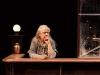
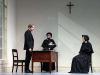
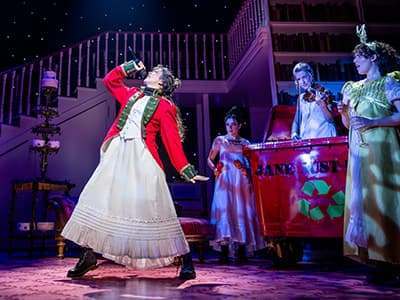
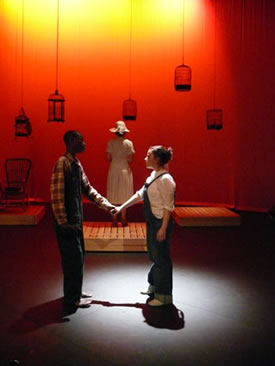
Director, Dino Dimitriadis, for Epicentre Theatre Company, has done a particularly fine job, in taking Christopher Sergel's adaptation of Lee's perennial novel to the stage, at Chatswood's Zenith. Clever directorial decisions (such as creating a sense of rural-scale distance by having characters face away from each other, while shouting across an imaginary field; 'freeze-frames' and 'slomo') have been consolidated with compliant lighting (Matt Cook) and set design (by Dimitriadis).
With regard to the former, single spots are used to intensify particular moments, as well as expositions of narrative and character. With regard to the latter, the duality of the metaphor (latent freedom vs. cultural, intellectual, moral and actual imprisonment) evoked by gilded cages, suspended at differing heights, is a pregnant one. Costumes, too, eloquently speak of the period.
The cast, too, has overwhelmingly embraced its parts with zeal. Claudette Clark epitomises Calpurnia, Atticus' live-in housekeeper & surrogate mother to his inquisitive 'chil'n'. Cat Martin is delightful, as the cake-bakin', wry Miss Maudie, whose moral compass is second only to Finch's. Wren Bowie makes for a convincing Miss Stephanie, the rather more witless, preened-and pressed middle-class expression of the bankrupt lynch-mob that is the small, small town setting. That many highschool students appeared to be present is no surprise: apart from a textual study, it's a vehicle for growth, outwards and inwards, in its address not only of prejudice, but poverty, mob rule, gender roles, justice, class and the true nature of courage.
In writing about an earlier time, it's, inevitably, a product of its own but, despite widely varying receptions, two accolades stand out on its behalf: a Pulitzer and a relatively survey of British librarians, who considered it a more important book to read than The Bible.
The book and, thus, this play still, unfortunately, rings all-too-true & familiar, even in an age of a black leader of the free world. Atticus Finch still stands as a model lawyer, sculpted from the hardest moral stone. In fictional terms, he is the heroic equivalent of Nelson Mandela, or Eddie Mabo. In viewing the play, so entrenched in loss of innocence, we all lose our innocence and moral virginity, all over again. All the moreso if done as well as Dimitriadis and company have managed.
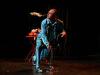
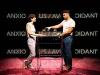
Matt Trendinnick, as sheriff, Heck Tate, gives an especially robust characterisation, lending hope eternal that real police might always aspire to his thinly-veiled compassion. Martin Bell carries just the right measure of pomp, as Judge Taylor. Abi Rayment delivers a veritably Tony-worthy Mrs Dubose. Young Luka Tanfara well-and-truly lives up to his character's name, as Jem. Ken Bernard seemed just a little unsure, as Reverend Sykes (no relation). Phil Lye was the very incarnation of evil ignorance, as Bob Ewell. Taryn Brine's Mayella did much to heighten the courtroom drama, exemplifying the confusion, anger and frustration of someone caught-out in a heinous lie. Sean Maroney's Dill was every bit as lovable as Huck Finn. Tim Warden triumphed in the exceptionally difficult task of an almost wordlessly enigmatic performance, as Arthur 'Boo' Radley. John Harrison, moreover, made a very decent show of borrowing from the popular and charismatic style of Gregory Peck, without coming off second-best. Adam Jacka's simpleton, Walter Cunningham, really hit the mark, too. Morgan Derera was effectively derisive & withering, as prosecutor, Mr Gilmer. Tim Wardell's tragic Tom Robinson was moving and, finally, Elijah Williams song was a scene-stealer. The only disappointment, ironically, was Eleni Dimitriadis, as Jean-Louise 'Scout' Finch. While her action was spirited, her diction meant hardly a word could be clearly understood. Voice work is implicated to straighten her otherwise promising path as an actor.
A worthy sidelight was, and is, the concurrent art exhibition, commissioned by the director, with some vivid and engaging work by Shira Bentley, Michael Bennett, Caitlyn Schroder, Allin Vartan-Boghossian and Sandra Williams.
Epicentre has done Harper Lee and, better yet, her themes, very proud.
Epicentre Theatre Company presents
To Kill a Mockingbird
Adapted by Christopher Sergel from Harper Lee’s novel
Directed by Dino Dimitriadis
Venue: Zenith Theatre Chatswood
Dates: 6 to 20 June 2009
Evenings: June 6,10,12,13,17,18,19 & 20 at 8pm
Matinees: June 13 (2pm) and June 14 (5pm)
Bookings: 9975 6780 | www.epicentretheatre.org.au